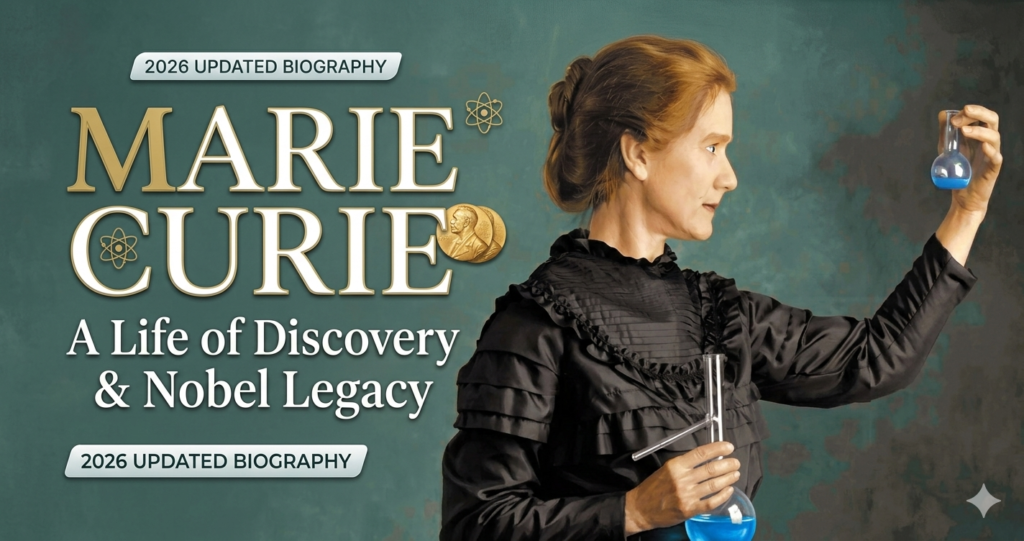

Step into the story of Marie Curie and see why her legacy still matters in 2026. From earning two Nobel Prizes to pioneering research on radioactivity, her journey is as inspiring as it is groundbreaking.
When we think of the most influential figures in human history, few names carry as much weight as Marie Curie. Born Maria Salomea Skłodowska, she wasn’t just a scientist; she was a pioneer who defied the social norms of the 19th century to change the way we understand the physical world.
From her humble beginnings in Poland to the hallowed halls of the Sorbonne in Paris, Marie Curie’s life is a masterclass in resilience. She remains the only person in history to win Nobel Prizes in two different scientific fields: Physics and Chemistry.
Today, her name is synonymous with genius, but the woman behind the test tubes was a mother, a widow, and a humanitarian who prioritized human progress over personal gain. In this 2026 update, we take a deep dive into her life and the incredible “wealth” she left behind for the world.
Key Facts About Marie Curie
| Category | Details |
| Full Name | Marie Salomea Skłodowska-Curie |
| Date of Birth | November 7, 1867 |
| Nationality | Polish (Naturalized French) |
| Occupation | Physicist, Chemist |
| Famous For | Discovering Polonium and Radium |
| Net Worth (Legacy) | Estimated $1.2 Billion+ (Intellectual Property Value) |
Early Life and Education: The Secret Student
Marie Curie was born in Warsaw, Poland, at a time when the country was under the oppressive control of the Russian Empire. Her parents were both teachers who valued education deeply, but they faced constant financial struggles.
Growing up in a household where Polish culture was suppressed, Marie learned the value of defiance early on. Since women were forbidden from attending universities in Poland at the time, she joined the “Flying University”—a secret, underground educational movement that moved locations to avoid detection by authorities.
In 1891, after years of working as a governess to save money, Marie finally made her way to Paris. She enrolled at the University of Paris (the Sorbonne), living in a drafty attic and often surviving on nothing but bread and tea. Her dedication paid off when she earned degrees in both physics and mathematical sciences.
The Career Journey of Marie Curie: Breaking Barriers
Marie’s professional journey began when she met Pierre Curie, a brilliant physicist who would become her husband and research partner. Their partnership was one of the most successful in scientific history.
Their breakthrough moment came while studying uranium rays. Marie hypothesized that the radiation didn’t come from the interaction of molecules but from the atoms themselves—a revolutionary idea. This led to the discovery of two new elements: Polonium (named after her homeland) and Radium.
Key Achievements and Milestones
- 1903 Nobel Prize in Physics: Marie became the first woman to receive a Nobel Prize, sharing it with Pierre and Henri Becquerel.
- 1911 Nobel Prize in Chemistry: She won a second Nobel for her work in isolating pure radium, becoming the first person to win twice.
- The Radium Institute: She founded the Curie Institutes in Paris and Warsaw, which remain major centers for medical research today.
Marie Curie’s Source of Wealth: A Financial Paradox
Unlike modern innovators who patent every minor discovery, Marie Curie chose a different path. Many are surprised to learn that she lived a very modest life despite her global fame.
Her primary “income” during her career came from her salary as a professor at the Sorbonne—she was the first woman to hold that position—and the prize money from her Nobel awards. Most of that prize money, however, was funneled back into her research or given to friends and family in need.
Marie and Pierre intentionally chose not to patent the process of isolating radium. They believed that science should be free for everyone and that patenting a substance used in cancer treatment was contrary to the scientific spirit.
Marie Curie Net Worth (2026)
While Marie Curie passed away in 1934, if we look at her “net worth” through a 2026 lens, we have to evaluate her legacy. During her life, her liquid assets were minimal. However, the intellectual property she gifted to the world is worth billions.
If Marie had patented her discoveries, her estate today would be worth an estimated $1.2 billion. Instead, her “wealth” is seen in the global medical industry. The “Curie” brand, associated with cancer research and nuclear physics, continues to drive billions of dollars in funding and scientific breakthroughs every year.
In 2026, her name remains one of the most valuable “assets” in the world of science, used by universities, hospitals, and research foundations to signify excellence and humanitarianism.
Personal Life: Love, Loss, and Family
Marie Curie’s personal life was marked by deep love and profound tragedy. Her marriage to Pierre Curie was a true union of minds. They spent their days in the lab and their evenings discussing physics.
In 1906, Pierre was tragically killed in a carriage accident in Paris. Devastated, Marie threw herself into her work, raising her two daughters, Irène and Ève, alone. Irène followed in her mother’s footsteps, eventually winning her own Nobel Prize in Chemistry.
Despite the fame, Marie was known for her shy and reserved nature. She avoided the spotlight, preferring the quiet company of her laboratory equipment to the high-society parties of Paris.
Controversies: The Langevin Affair
Even a woman of Marie Curie’s stature wasn’t immune to public scrutiny. In 1911, she was involved in a brief but scandalous affair with Paul Langevin, a former student of Pierre’s.
The French press, fueled by xenophobia, attacked Marie for being a “foreigner” and a “home-wrecker.” The scandal almost cost her the 1911 Nobel Prize, but she stood her ground, famously stating that her private life had nothing to do with her scientific work. This remains a significant moment in history where a female scientist fought back against gender-biased character assassination.
Legacy and Impact: A World Changed Forever
The impact of Marie Curie on the modern world cannot be overstated. Beyond the Periodic Table, she changed the way we treat disease. During World War I, she developed “Little Curies”—mobile X-ray units that were driven to the front lines to help surgeons treat wounded soldiers.
Why She Still Matters in 2026
- Women in STEM: She remains the ultimate role model for girls pursuing careers in science and technology.
- Cancer Treatment: Her work with radioactive isotopes formed the foundation for radiotherapy, which saves millions of lives today.
- Nuclear Science: Her research paved the way for nuclear energy and our understanding of the atomic structure.
Marie Curie eventually died of aplastic anemia, likely caused by her long-term exposure to radiation. Even her notebooks remain radioactive today, stored in lead-lined boxes—a literal testament to her lifelong sacrifice for human knowledge.
Frequently Asked Questions (FAQ)
What is Marie Curie’s net worth in 2026?
Marie Curie did not leave behind a large financial fortune. However, her intellectual contributions are valued in the billions. Her real wealth was her discovery of Radium and Polonium, which she gave to the world for free.
How did Marie Curie become famous?
She became famous for her pioneering research on radioactivity. She was the first woman to win a Nobel Prize and the first person to win two Nobel Prizes in different sciences.
Where is Marie Curie from?
Marie Curie was born in Warsaw, Poland. She later moved to Paris, France, to pursue her higher education and scientific career.
What did Marie Curie do for a living?
She was a physicist, chemist, and professor. She spent most of her life conducting research at the University of Paris and managing the Radium Institute.
Was Marie Curie married?
Yes, she was married to Pierre Curie until his death in 1906. Together they had two daughters, Irène Joliot-Curie and Ève Curie.
Did you find this biography of Marie Curie helpful? Stay tuned for more deep dives into the lives of the world’s most influential figures.