
Last Updated: May 2026
Written by Daniel Mercer
Technology and Innovation Journalist
Daniel Mercer covers artificial intelligence, Silicon Valley culture, startup ecosystems, and emerging technologies. His reporting focuses on the intersection of technology, business, ethics, and society.
Sam Altman Didn’t Just Build a Company. He Helped Change the Direction of Technology.
Very few technology executives become symbols of an entire era.
Steve Jobs became associated with the personal computing revolution. Mark Zuckerberg became tied to the social media age. Elon Musk helped redefine conversations around electric vehicles and private space travel.
For artificial intelligence, that figure is increasingly Sam Altman.
As the CEO of OpenAI, the company behind ChatGPT, Altman has become one of the most influential and debated people in modern technology. His work sits at the center of a global transformation affecting education, business, software, media, science, politics, and even human creativity itself.
To supporters, he represents innovation at extraordinary speed.
To critics, he represents the growing concentration of power surrounding artificial intelligence.
Either way, the Sam Altman story is no longer simply a Silicon Valley success story.
It is now deeply connected to the future of how humanity interacts with machines.
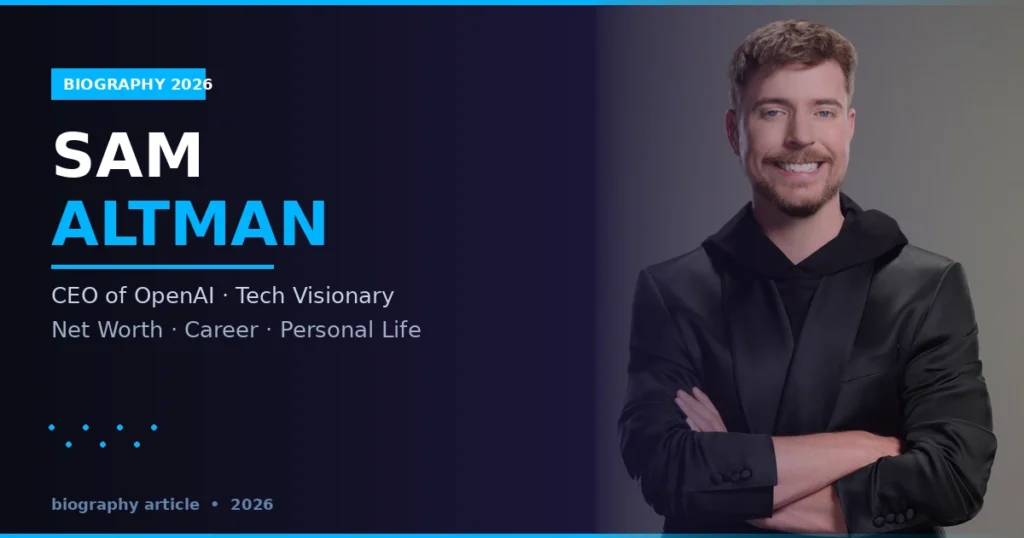
This Sam Altman biography explores his early life, rise through Silicon Valley, leadership at OpenAI, net worth in 2026, controversies, investments, personal life, and long-term impact on artificial intelligence.
Quick Facts About Sam Altman
| Detail | Information |
|---|---|
| Full Name | Samuel Harris Altman |
| Known As | Sam Altman |
| Date of Birth | April 22, 1985 |
| Age (2026) | 41 years old |
| Birthplace | Chicago, Illinois, USA |
| Raised In | St. Louis, Missouri |
| Nationality | American |
| Occupation | Entrepreneur, Investor, CEO of OpenAI |
| Education | Stanford University (dropped out) |
| Known For | OpenAI, ChatGPT, Y Combinator |
| Net Worth (2026) | Estimated $2.5 billion to $3 billion |
Early Life and Childhood
Samuel Harris Altman was born on April 22, 1985, in Chicago, Illinois, but spent most of his childhood growing up in St. Louis, Missouri.
He was raised in a Jewish family alongside his siblings in an intellectually curious household.
His mother worked as a dermatologist, while his father worked in real estate.
From an early age, Altman displayed the kind of obsessive curiosity often associated with future engineers and entrepreneurs.
According to interviews he later gave during his rise in Silicon Valley, he received his first Macintosh computer at the age of eight.
Instead of simply using it, he reportedly took it apart to understand how it worked.
That combination of technical curiosity and analytical thinking would become one of the defining characteristics of his career.
Unlike many celebrity technology founders who cultivate larger-than-life public personas, Altman developed a reputation for being calm, highly strategic, and unusually thoughtful in conversation.
Even as a teenager, friends and teachers reportedly viewed him as someone intensely interested in the future.
Education and the Stanford Years
Altman enrolled at Stanford University in 2003 to study computer science.
At the time, Silicon Valley was entering a new phase.
Google was expanding rapidly, Facebook had just launched, and startup culture was becoming increasingly attractive to ambitious young programmers.
Like several famous technology founders before him, Altman ultimately decided that the opportunities outside the classroom were moving faster than the opportunities inside it.
In 2005, after approximately two years at Stanford, he dropped out to launch his first startup.
The decision reflected a pattern that would define much of his career:
- move quickly
- embrace calculated risk
- prioritize execution over tradition
That startup was called Loopt.
Sam Altman’s First Startup: Loopt
Loopt was an early location-sharing social networking application that allowed users to share their real-time locations with friends.
Today, location sharing is standard across apps like Snapchat, Instagram, and Google Maps.
In the mid-2000s, however, the concept was still experimental.
Loopt became one of the early startups funded by Y Combinator, the influential startup accelerator founded by entrepreneur and investor Paul Graham.
Although Loopt never became a mainstream breakout success, it earned Altman valuable credibility inside Silicon Valley.
In 2012, the company was acquired by Green Dot Corporation for approximately $43 million.
The exit was modest compared to later Silicon Valley mega-deals, but it accomplished something important:
It established Sam Altman as a serious technology founder.
The experience also connected him to the growing network of founders, venture capitalists, and startup operators who would later shape the modern tech industry.
Y Combinator and the Rise of Sam Altman
In 2014, Paul Graham selected Sam Altman to become president of Y Combinator.
At just 28 years old, Altman suddenly found himself leading one of the most powerful startup accelerators in the world.
Y Combinator had already funded companies such as:
- Airbnb
- Dropbox
- Stripe
- Coinbase
- Twitch
Under Altman’s leadership, the organization expanded aggressively.
He increased the number of startups accepted into each funding batch and helped transform Y Combinator from a respected Silicon Valley incubator into a globally recognized technology institution.
During his time there, Altman developed a reputation for identifying unusually ambitious founders early.
He also became one of the most connected people in the startup world.
Entrepreneurs frequently described him as:
- analytical
- calm under pressure
- deeply optimistic about technology
- unusually good at spotting future trends
At the same time, he increasingly shifted his attention toward artificial intelligence.
That interest would eventually define his career.
The Creation of OpenAI
In 2015, Sam Altman co-founded OpenAI alongside several prominent technology figures, including:
- Elon Musk
- Greg Brockman
- Ilya Sutskever
- Wojciech Zaremba
- John Schulman
The organization launched as a nonprofit artificial intelligence research company.
Its stated mission was ambitious:
To ensure that artificial general intelligence (AGI) benefits all of humanity.
At the time, artificial intelligence was still viewed primarily as a specialized research field rather than a mainstream consumer technology.
That changed rapidly over the next several years.
OpenAI initially focused heavily on:
- machine learning research
- neural networks
- reinforcement learning
- large-scale AI models
As development costs increased, OpenAI evolved into a capped-profit structure in 2019, a controversial but strategic move designed to attract the enormous capital required for advanced AI research.
That same year, Sam Altman officially became CEO of OpenAI.
ChatGPT and Global Fame
Everything changed in November 2022.
That was when OpenAI launched ChatGPT publicly.
The product exploded across the internet almost immediately.
Within five days, ChatGPT reportedly surpassed one million users.
Within months, it became one of the fastest-growing consumer applications in technology history.
Suddenly, millions of people who had never interacted with advanced AI before were:
- writing essays
- generating code
- creating business plans
- translating languages
- asking philosophical questions
- automating work tasks
using conversational AI tools.
The launch transformed OpenAI from a respected research lab into one of the most influential companies in the world.
It also transformed Sam Altman into a globally recognized public figure.
By 2026, OpenAI products are used by hundreds of millions of people across industries including:
- education
- healthcare
- finance
- software development
- media
- customer service
- research
The release of ChatGPT is widely viewed as one of the defining technology moments of the 2020s.
The 2023 OpenAI Crisis
In November 2023, Sam Altman’s career experienced its most dramatic public moment.
OpenAI’s board unexpectedly announced that Altman had been removed as CEO.
The board stated that it no longer had confidence in his leadership and cited concerns regarding transparency in communications.
The decision triggered immediate chaos across the technology industry.
Employees revolted.
Investors panicked.
Microsoft, OpenAI’s largest strategic partner, reportedly prepared to hire Altman directly.
More than 700 OpenAI employees threatened to resign unless he returned.
Within less than a week, Altman was reinstated as CEO and OpenAI’s board structure was reshaped.
The episode became one of the most dramatic leadership crises in Silicon Valley history.
For many observers, it highlighted a deeper issue:
Who should control technologies powerful enough to potentially reshape entire societies?
The incident ultimately strengthened Altman’s public influence rather than weakening it.
Sam Altman’s Investments and Business Ventures
Although OpenAI dominates public attention surrounding Altman, his business interests extend far beyond a single company.
Over the years, he became an active investor in major technology startups.
His investment portfolio reportedly includes early stakes in:
- Stripe
- Airbnb
- Asana
- Helion Energy
- Retro Biosciences
Many of those investments later became billion-dollar companies.
World (Formerly Worldcoin)
One of Altman’s most controversial ventures is World, formerly known as Worldcoin.
The project combines:
- cryptocurrency
- digital identity verification
- biometric technology
Users verify their identity through iris-scanning devices called Orbs.
Supporters argue the system could help distinguish humans from AI systems online in the future.
Critics, however, raised concerns about:
- biometric privacy
- surveillance risks
- data security
- consent issues
Several countries launched investigations or imposed restrictions related to the project.
Despite controversy, World remains one of the most ambitious digital identity projects in the AI era.
Energy and Longevity Investments
Altman has also invested heavily in futuristic industries.
His interests include:
- nuclear energy
- fusion power
- longevity science
- biotechnology
- climate technology
He has backed companies such as Oklo and Helion Energy, reflecting his belief that future civilizations will require enormous energy infrastructure to support advanced AI systems.
Sam Altman Net Worth in 2026
As of 2026, Sam Altman’s estimated net worth is believed to range between $2.5 billion and $3 billion.
Unlike many billionaires whose wealth is concentrated in publicly traded shares, Altman’s fortune is largely tied to:
- startup equity
- private company investments
- venture stakes
- technology partnerships
His financial growth accelerated significantly following OpenAI’s rapid valuation increase.
OpenAI has reportedly reached valuations exceeding $150 billion during private funding discussions.
Altman’s investment portfolio also contributes substantially to his wealth.
However, because many of his holdings remain private and illiquid, exact figures can vary significantly depending on market conditions and company valuations.
Personal Life
Sam Altman is openly gay.
In 2016, he publicly discussed his sexuality in a blog post about identity and life within the technology industry.
He has been in a long-term relationship with Australian software engineer Oliver Mulherin.
Compared to many famous technology billionaires, Altman maintains a relatively understated public image.
He is known for:
- minimalist communication style
- long-form thinking
- interest in science fiction
- intense reading habits
- future-focused discussions
Altman has also spoken publicly about survival preparedness and long-term civilizational risks.
In various interviews and podcasts, he has mentioned keeping emergency supplies and thinking carefully about how humanity might respond to global disruption scenarios.
Some people view this as eccentric.
Others see it as entirely logical for someone helping build advanced artificial intelligence systems.
Controversies and Criticism
AI Safety Concerns
One of the largest criticisms surrounding Sam Altman involves the speed of AI development.
Although Altman frequently warns about the potential dangers of artificial intelligence, critics argue that OpenAI continues releasing increasingly powerful systems faster than regulators can respond.
Former OpenAI employees, AI ethicists, and some researchers have questioned whether commercial competition is beginning to outweigh safety considerations.
The debate remains ongoing.
OpenAI Governance Questions
The 2023 firing incident exposed concerns about OpenAI’s unusual governance structure.
Unlike traditional corporations, OpenAI was initially designed around nonprofit oversight principles.
As the company became commercially powerful, tensions emerged between:
- research goals
- safety concerns
- investor expectations
- global competition
Those tensions continue shaping discussions about the future regulation of artificial intelligence.
Privacy and World Investigations
World’s biometric identity system triggered investigations in multiple countries, including:
- Kenya
- Spain
- France
- Germany
Regulators questioned how biometric data was collected, stored, and protected.
The project remains active, but scrutiny around privacy and surveillance concerns continues.
Sam Altman’s Legacy and Global Impact
Sam Altman’s long-term legacy is still being written.
But even at this stage of his career, his influence on technology history is undeniable.
He helped push artificial intelligence from a specialized technical field into mainstream global life.
Under his leadership, AI became:
- a business tool
- an educational tool
- a creative tool
- a political issue
- a geopolitical issue
- a workplace issue
almost simultaneously.
Governments around the world now debate AI regulation partly because systems like ChatGPT advanced so quickly.
Entire industries are reorganizing around AI-assisted workflows.
At the same time, fears surrounding misinformation, automation, privacy, and job displacement continue growing.
That complexity is part of what makes the Sam Altman biography so compelling.
He represents both the excitement and the uncertainty surrounding artificial intelligence.
To supporters, he is a visionary helping humanity build transformative tools.
To skeptics, he is accelerating technologies society may not yet fully understand.
In 2026, both interpretations remain active.
And that tension may ultimately define the AI era itself.
Sam Altman Career Timeline
| Year | Milestone |
|---|---|
| 2005 | Drops out of Stanford University |
| 2005 | Co-founds Loopt |
| 2012 | Loopt acquired by Green Dot |
| 2014 | Becomes president of Y Combinator |
| 2015 | Co-founds OpenAI |
| 2019 | Becomes CEO of OpenAI |
| 2022 | OpenAI launches ChatGPT |
| 2023 | Fired and reinstated as OpenAI CEO |
| 2026 | Leads OpenAI during global AI expansion |
Frequently Asked Questions About Sam Altman
What is Sam Altman’s net worth in 2026?
Sam Altman’s estimated net worth in 2026 is between $2.5 billion and $3 billion.
How did Sam Altman become famous?
He became globally famous as the CEO of OpenAI following the explosive success of ChatGPT in 2022.
Did Sam Altman finish college?
No. Altman dropped out of Stanford University in 2005 to launch his startup Loopt.
What companies has Sam Altman invested in?
He has invested in companies including Stripe, Airbnb, Reddit, Pinterest, Asana, and several AI and energy startups.
Why was Sam Altman fired from OpenAI?
OpenAI’s board removed him in November 2023 over concerns related to communication and leadership transparency. He was reinstated within days after widespread backlash.
Is Sam Altman married?
As of 2026, Sam Altman is not publicly married. He has been in a long-term relationship with Australian software engineer Oliver Mulherin.
Editorial Note
Biography Hub independently researches and verifies biographies using interviews, public records, technology reporting, company statements, and verified media sources. Net worth estimates are based on publicly available financial reporting and market analysis.
Sources and References
This article references publicly available information from:
- OpenAI
- The New York Times
- Bloomberg
- Forbes
- Wired
- TechCrunch
- Y Combinator
- Stanford University
- CNBC
- The Wall Street Journal
- Official interviews and verified media reports