
Last Updated: May 2026
Written by Adrian Cole
Technology and Business Journalist
Adrian Cole covers artificial intelligence, semiconductors, Silicon Valley leadership, and the global technology economy. His reporting focuses on the people and companies shaping the infrastructure of modern computing.
Jensen Huang Didn’t Just Build NVIDIA. He Helped Build the Foundation of Artificial Intelligence.
Before artificial intelligence transformed global business, before ChatGPT became a household name, and before governments began racing to secure AI dominance, Jensen Huang was quietly building the hardware powering it all.
For decades, NVIDIA was known primarily as a gaming graphics company.
Then the world realized its chips were becoming the engines of the AI revolution.
Today, Jensen Huang stands among the most influential technology executives alive. As co-founder and CEO of NVIDIA Corporation, he transformed a struggling semiconductor startup into one of the most valuable companies in human history.
His story reads almost improbably:
A Taiwanese immigrant child sent alone to America.
A teenager working at Denny’s.
A young engineer sleeping little and working relentlessly.
A founder who nearly lost his company multiple times before turning it into the backbone of modern AI infrastructure.
By 2026, Huang is not simply a billionaire tech executive.
He is one of the defining industrial architects of the 21st century.
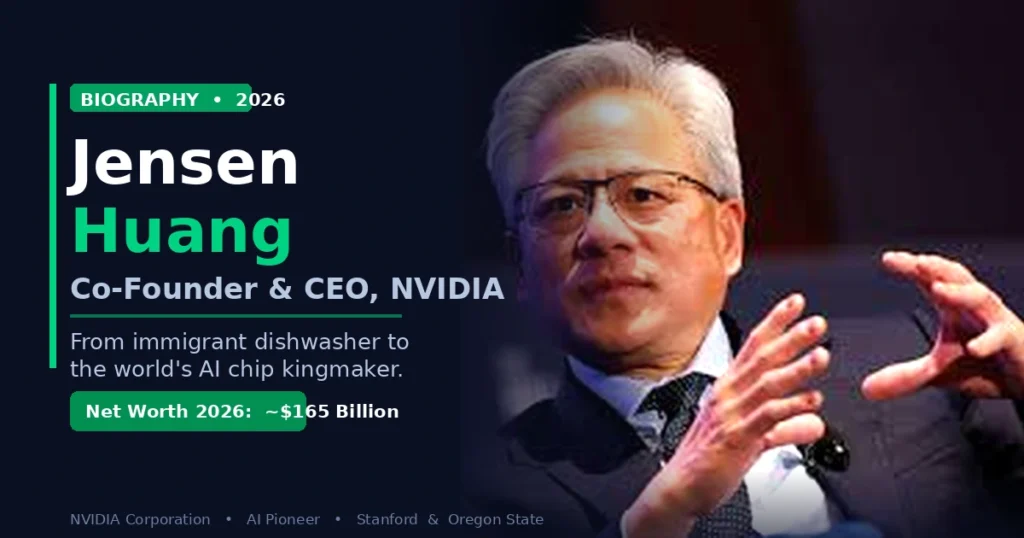
This Jensen Huang biography explores his early life, immigrant journey, education, rise at NVIDIA, net worth in 2026, leadership philosophy, controversies, personal life, and long-term impact on artificial intelligence and computing.
Quick Facts About Jensen Huang
| Detail | Information |
|---|---|
| Full Name | Jen-Hsun Huang |
| Known As | Jensen Huang |
| Date of Birth | February 17, 1963 |
| Age (2026) | 63 years old |
| Birthplace | Tainan, Taiwan |
| Nationality | Taiwanese-American |
| Occupation | Entrepreneur, Electrical Engineer, CEO |
| Company | NVIDIA Corporation |
| Position | Co-Founder, President, CEO |
| Education | Oregon State University, Stanford University |
| Net Worth (2026) | Estimated $160 billion to $181 billion |
| Spouse | Lori Mills Huang |
| Children | Madison Huang, Spencer Huang |
Early Life: A Childhood Shaped by Displacement and Survival
Jen-Hsun Huang was born on February 17, 1963, in Tainan, Taiwan.
His father worked as a chemical engineer while his mother was a schoolteacher, creating a household deeply centered around discipline and education.
During his early childhood, the family relocated to Thailand for work opportunities.
But geopolitical instability in Southeast Asia during the Vietnam War era created uncertainty about the future.
Concerned for their children’s safety and opportunities, Huang’s parents made a life-changing decision:
They sent Jensen and his older brother alone to the United States.
He was only nine years old.
The brothers arrived in Tacoma, Washington, where an uncle mistakenly enrolled them at the Oneida Baptist Institute in rural Kentucky.
The school was not the elite boarding academy their family imagined.
It was effectively a reform school housing troubled youth and students from difficult backgrounds.
For the young Huang, the experience was harsh.
He later described:
- bullying
- racial slurs
- social isolation
- daily labor assignments
including cleaning bathrooms and toilets.
His brother worked on a tobacco farm nearby.
The experience could have broken his confidence.
Instead, it hardened his resilience.
Years later, Huang would donate millions of dollars back to the same school that once represented one of the hardest periods of his childhood.
Eventually, his parents reunited the family and moved them to Portland, Oregon, where life stabilized significantly.
There, Huang attended Aloha High School and developed a reputation for intelligence, competitiveness, and unusual focus.
He also became a nationally ranked junior table tennis player, demonstrating the intense discipline that would later define his leadership style.
Education: Engineering Mindset Meets Relentless Work Ethic
Jensen Huang enrolled at Oregon State University (OSU), largely because it was affordable and respected for engineering.
The decision would shape the rest of his life.
At OSU, he studied electrical engineering and graduated in 1984 with highest honors.
He later joked that he looked younger than nearly everyone else in his graduating class, a reflection of how early he advanced academically.
More importantly, OSU introduced him to Lori Mills, an engineering student who later became his wife.
Even during university, Huang displayed an unusually aggressive work ethic.
He balanced academics with constant technical experimentation and developed an obsession with understanding how computing systems worked at the hardware level.
After graduation, he entered Silicon Valley during a transformative period for semiconductors and personal computing.
While working full-time in the industry, Huang later pursued graduate studies at Stanford University, earning a Master of Science in Electrical Engineering in 1992.
The combination of:
- practical chip design experience
- advanced engineering education
- startup exposure
created the foundation for what came next.
Early Career: AMD and LSI Logic
Huang began his professional career at Advanced Micro Devices (AMD), where he worked as a microprocessor designer and engineer.
At AMD, he gained firsthand experience inside the competitive semiconductor industry.
He later joined LSI Logic Corporation, where he rose into leadership positions and managed engineering teams working on advanced chip systems.
It was during this period that Huang began recognizing something many people overlooked:
Graphics processing was going to become massively important.
At LSI Logic, he met engineers Chris Malachowsky and Curtis Priem.
The three shared a belief that specialized graphics hardware could dramatically change computing performance.
That belief became the foundation of NVIDIA.
The Denny’s Origin Story
In 1993, Jensen Huang, Chris Malachowsky, and Curtis Priem co-founded NVIDIA Corporation.
The company was famously conceived during conversations at a Denny’s restaurant in San Jose, California.
Huang was 30 years old.
He later recalled telling Lori years earlier that he would become a CEO by the age of 30.
Remarkably, he did.
But the early years of NVIDIA were brutal.
The company nearly collapsed multiple times.
Its early graphics chips struggled commercially, and financial pressure mounted rapidly.
At one point, Huang negotiated a critical partnership with Sega that helped keep NVIDIA alive long enough to recover.
That period permanently shaped his management philosophy.
He later described NVIDIA as being “30 days from going out of business” more than once.
The survival mentality became embedded in the company culture.
The GPU Revolution
In 1999, NVIDIA launched the GeForce 256, widely recognized as the world’s first GPU (Graphics Processing Unit).
The release changed the gaming industry permanently.
Instead of treating graphics as a secondary computer function, NVIDIA positioned GPUs as specialized processors capable of handling enormous parallel workloads.
Gaming graphics suddenly became dramatically more immersive and realistic.
NVIDIA quickly established dominance within PC gaming hardware.
But Huang was already thinking beyond gaming.
He believed GPUs would eventually power entirely new categories of computing.
At the time, that vision sounded overly ambitious.
In hindsight, it was one of the most important strategic predictions in technology history.
NVIDIA and the Artificial Intelligence Explosion
The turning point came during the deep learning boom of the early 2010s.
Researchers discovered that NVIDIA GPUs were extraordinarily effective at training neural networks because they could process massive numbers of calculations simultaneously.
At the same time, NVIDIA had already developed CUDA, a software platform allowing developers to harness GPU computing power for applications beyond gaming.
That combination proved transformative.
When artificial intelligence accelerated globally in the 2020s, NVIDIA was already positioned at the center of the industry.
Then came generative AI.
The launch of AI systems such as ChatGPT triggered an unprecedented global demand for:
- AI chips
- data center infrastructure
- machine learning hardware
NVIDIA became the dominant supplier.
Its H100, Blackwell, and subsequent AI chips became some of the most sought-after hardware products in the world.
By 2025:
- NVIDIA surpassed a $5 trillion market valuation
- data centers worldwide depended on NVIDIA hardware
- governments viewed AI chips as strategic infrastructure
The company evolved from a semiconductor business into the backbone of modern artificial intelligence.
And Jensen Huang became the public face of the AI hardware era.
Jensen Huang Net Worth in 2026
As of 2026, Jensen Huang’s estimated net worth ranges between $160 billion and $181 billion.
The majority of his wealth comes from his ownership stake in NVIDIA.
Although he owns only a relatively small percentage of the company, NVIDIA’s explosive valuation growth transformed that stake into one of the largest fortunes on Earth.
His wealth increased dramatically during the AI boom:
- approximately $77 billion in 2024
- roughly $99 billion in 2025
- over $160 billion by 2026
Because most of his fortune is tied directly to NVIDIA stock, daily market fluctuations can move his net worth by billions of dollars within hours.
Unlike some billionaires whose wealth comes from diversified holdings or inherited assets, Huang’s fortune is overwhelmingly connected to the company he spent decades building.
Source of Wealth
Jensen Huang’s wealth primarily comes from:
1. NVIDIA Equity Ownership
His largest financial asset remains his long-held NVIDIA shares.
As NVIDIA’s valuation surged during the AI expansion, the value of those shares multiplied dramatically.
2. Executive Compensation
As CEO of NVIDIA, Huang receives:
- salary
- stock awards
- performance incentives
- executive compensation packages
However, these represent only a small fraction of his total wealth relative to his equity holdings.
3. Investments and Foundation Assets
Huang and his wife established the Jen-Hsun and Lori Huang Foundation, which manages billions of dollars in philanthropic and investment assets tied to:
- education
- healthcare
- STEM initiatives
- university partnerships
Leadership Style and Public Persona
Jensen Huang has become one of the most recognizable executives in global technology.
Part of that visibility comes from his presentation style.
Unlike many CEOs who rely heavily on corporate polish, Huang often appears intensely technical, energetic, and deeply immersed in product details.
He is famous for:
- marathon product keynotes
- highly technical presentations
- direct communication
- obsessive preparation
- his signature black leather jacket
The jacket itself became a Silicon Valley symbol during the AI boom, almost functioning as a modern equivalent of Steve Jobs’ black turtleneck.
Internally, Huang is known for demanding exceptionally high standards.
Former employees frequently describe NVIDIA’s culture as:
- intense
- fast-moving
- deeply competitive
- engineering-focused
But many also credit Huang’s long-term vision for the company’s survival and dominance.
Personal Life
Jensen Huang married Lori Mills in 1988 after meeting her during their engineering studies at Oregon State University.
According to Huang’s often-repeated story, he approached Lori and confidently promised that if she studied with him every Sunday, she would earn straight A’s.
The relationship lasted.
The couple has two children:
- Madison Huang
- Spencer Huang
Both later became involved professionally with NVIDIA-related operations and product ecosystems.
Despite enormous wealth, Huang maintains a relatively restrained public lifestyle compared to many high-profile billionaires.
His public identity remains heavily centered on:
- engineering
- technology
- leadership
- innovation
rather than celebrity culture.
Controversies and Regulatory Pressure
Jensen Huang has largely avoided personal scandal throughout his career.
However, NVIDIA’s dominance has attracted increasing regulatory and geopolitical scrutiny.
U.S.-China AI Chip Restrictions
As AI competition intensified globally, the U.S. government imposed restrictions on exporting advanced AI chips to China.
NVIDIA became central to those debates.
American lawmakers questioned:
- national security risks
- semiconductor exports
- global AI competition
- dependence on NVIDIA hardware
Huang has attempted to navigate these tensions carefully while protecting NVIDIA’s global business interests.
Antitrust Concerns
NVIDIA’s extraordinary dominance in AI hardware has also triggered antitrust discussions in:
- the United States
- the European Union
- parts of Asia
Critics worry that excessive concentration of AI infrastructure power could reduce competition across the technology industry.
As of 2026, however, no major legal actions personally targeting Huang have emerged.
Philanthropy and Giving Back
Huang’s philanthropic efforts have grown significantly alongside his wealth.
Through the Jen-Hsun and Lori Huang Foundation, the family has donated substantial sums toward:
- universities
- engineering education
- healthcare
- STEM research
- public institutions
One of the most symbolic donations went to the Oneida Baptist Institute, the same school where Huang once cleaned toilets as an immigrant child struggling to adapt to life in America.
The gesture reflected a recurring theme throughout his life:
Turning adversity into long-term purpose.
Legacy: Why Jensen Huang Matters
Jensen Huang’s importance extends far beyond personal wealth.
He recognized decades before most executives that GPUs would become foundational to the future of computing.
That single strategic insight helped shape:
- artificial intelligence
- machine learning
- autonomous vehicles
- scientific research
- robotics
- data center infrastructure
Today, much of modern AI runs on NVIDIA hardware.
That reality gives Huang an influence few technology leaders in history have possessed.
His story also represents something larger than business success.
It is an immigrant story.
An engineering story.
A resilience story.
A long-term thinking story.
He spent decades building infrastructure before the world fully understood why it mattered.
By 2026, the answer is impossible to miss.
Jensen Huang Career Timeline
| Year | Milestone |
|---|---|
| 1963 | Born in Tainan, Taiwan |
| 1972 | Moves to the United States |
| 1984 | Graduates from Oregon State University |
| 1992 | Earns Master’s degree from Stanford |
| 1993 | Co-founds NVIDIA |
| 1999 | Launches GeForce 256 GPU |
| 2006 | Expands CUDA platform |
| 2022 | AI demand accelerates globally |
| 2025 | NVIDIA surpasses $5 trillion valuation |
| 2026 | Remains one of the world’s richest people |
Frequently Asked Questions (FAQ)
What is Jensen Huang’s net worth in 2026?
Jensen Huang’s estimated net worth in 2026 is approximately $160 to $181 billion, depending on NVIDIA’s stock price at the time of measurement. Forbes placed him at around $180.8 billion in April 2026, making him one of the ten wealthiest people in the world.
How did Jensen Huang become famous?
Huang became famous as the co-founder and CEO of NVIDIA Corporation, which he built from a small 1993 startup into the world’s leading provider of GPU chips for gaming and artificial intelligence. His fame accelerated dramatically during the AI boom of the 2020s, when NVIDIA became indispensable to the global technology industry.
Where is Jensen Huang from?
Jensen Huang was born in Tainan, Taiwan. His family later moved to Thailand, and he immigrated to the United States at age nine. He grew up in Portland, Oregon, and built his career in Silicon Valley, California. He is a naturalized American citizen.
What does Jensen Huang do for a living?
Jensen Huang is the co-founder, President, and CEO of NVIDIA Corporation, a position he has held since the company’s founding in 1993. He also serves on various advisory boards, including the President’s Council of Advisors on Science and Technology (PCAST).
Is Jensen Huang married?
Yes. Jensen Huang has been married to Lori Mills since 1988. The couple met as engineering students at Oregon State University. They have two adult children, Madison and Spencer, both of whom work at NVIDIA.
What made NVIDIA so valuable?
NVIDIA’s GPUs, originally built for gaming, turned out to be ideal for training machine learning models due to their ability to handle thousands of parallel calculations simultaneously. As artificial intelligence became central to global technology infrastructure, demand for NVIDIA chips surged — driving the company’s market cap past $5 trillion in 2025.
Editorial Note
BiographyHub independently researches and reviews biographies using verified interviews, company filings, public financial reporting, technology journalism, and reputable media sources. Net worth estimates are based on publicly available market data and may fluctuate significantly with stock performance.
Sources and References
This article references publicly available information from:
- NVIDIA Corporation
- Forbes
- Bloomberg
- The Wall Street Journal
- CNBC
- Stanford University
- Oregon State University
- SEC filings
- Verified interviews and keynote presentations