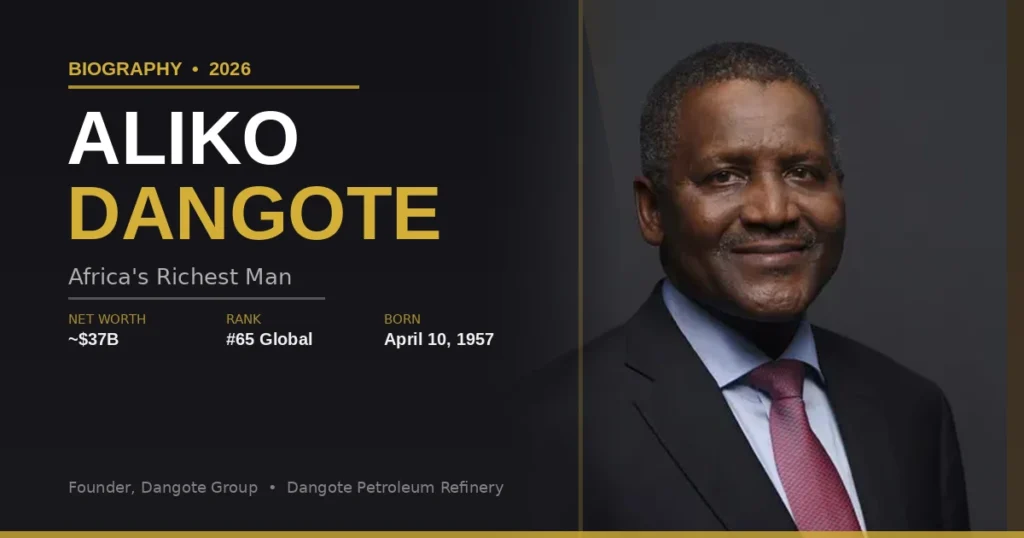

Aliko Dangote’s story is the definitive look at modern African industry. We’re going to guide you through the journey of the man behind the empire from his early beginnings in Kano to his long-standing position as the continent’s wealthiest individual. This 2026 update covers his business roots, his current net worth, and the industrial legacy he continues to build across Africa.
Aliko Dangote is not just a name he is a symbol. Born in northern Nigeria and now recognised as the wealthiest person on the entire African continent, Dangote has built an industrial empire that stretches across more than ten countries and touches the daily lives of hundreds of millions of people. As of 2026, the Dangote biography is more compelling than ever, with his net worth surging past $35 billion and a historic oil refinery reshaping Nigeria’s energy future.
This is the definitive look at the man behind the name.
Quick Facts: Aliko Dangote at a Glance
| Detail | Information |
|---|---|
| Full Name | Aliko Mohammad Dangote |
| Date of Birth | April 10, 1957 |
| Place of Birth | Kano, Kano State, Nigeria |
| Nationality | Nigerian |
| Occupation | Businessman, Industrialist, Philanthropist |
| Net Worth (2026) | ~$35–37 billion (Bloomberg) |
| Known For | Dangote Group, Dangote Refinery, Dangote Cement |
| Award | Grand Commander of the Order of the Niger (GCON) |
Early Life and Family Background
Aliko Dangote was born on April 10, 1957, in Kano, one of Nigeria’s most historically significant commercial cities. He came into the world with a head start that most people only dream about and yet, what he built far exceeds anything his inheritance could have given him.
His family name carries serious weight in West African business history. His maternal great-grandfather, Alhassan Abdullahi Dantata, was widely regarded as the richest man in West Africa before his death in 1955. That legacy of commerce was baked into the Dangote bloodline long before Aliko took his first steps.
His father, Mohammed Dangote, ran a transport company, while his mother, Mariya (née Dantata), was a businesswoman and philanthropist in her own right. Tragically, his father passed away in 1965, when Aliko was just eight years old. From that point, his maternal grandfather, Sanusi Dantata, stepped in as a guiding figure a building materials trader whose practical business sense would quietly shape the young boy’s worldview.
Dangote has three siblings. Sani Dangote, a fellow businessman, passed away from colorectal cancer. His brother Bello died in a plane crash in 1996, and Garba died in 2013 following a stroke. Loss, it seems, has been a thread woven throughout his personal story yet it has never slowed his ambition.
Education: From Kano to Cairo
Dangote received his early education at Sheikh Ali Kumasi Madrasa in Kano, followed by Capital High School, also in Kano. He later completed his secondary education at Government College, Birnin Kudu, graduating in 1978.
He then travelled abroad to pursue higher education at Al-Azhar University in Cairo, Egypt, one of the world’s oldest and most prestigious institutions. He earned a degree in Business Studies a qualification that gave formal structure to what was already a deeply entrepreneurial instinct.
There is a famous story, almost too perfect to be coincidence, that captures who Dangote always was: as a child, he would buy sweets, boil them, and resell them to classmates at a profit. He was eight years old. The margin was small, but the mindset was already fully formed.
Career Journey: From $3,000 to $35 Billion
The First Step: A Loan and a Vision
When Dangote returned to Nigeria after university, he did not wait for opportunity to knock. He knocked down the door himself.
In 1977, at just twenty years old, he launched his first business with a loan of approximately $3,000 from his uncle. He used it to trade in commodities sugar, cement, salt, and foodstuffs. It was unglamorous work, but it was profitable, and Dangote understood something that many of his peers did not: Nigeria was a nation of 200 million people with enormous unmet demand for basic goods.
In 1981, he formally incorporated Dangote Nigeria Limited, which later evolved into the Dangote Group. Throughout the 1980s and 1990s, he expanded his trading operation to include rice, flour, milk, fish, and industrial raw materials like steel and aluminium.
The Pivot That Changed Everything
The real turning point came in 1996, when Dangote travelled to Brazil to study manufacturing operations firsthand. He returned with a new conviction: Nigeria should not just import goods it should make them.
That insight led him to pivot the entire Dangote Group from trading to manufacturing. The logic was straightforward but powerful. A growing population, minimal local production capacity, and heavy dependence on imports was a gap waiting to be filled. Dangote decided to fill it.
Dangote Cement: The Breakout
The founding of Dangote Cement was the move that transformed him from a wealthy trader into a bona fide industrial titan. As Nigeria’s infrastructure needs exploded in the 2000s, demand for cement skyrocketed and Dangote was positioned to supply it.
Today, Dangote Cement is the largest cement producer in sub-Saharan Africa, with a production capacity of around 55 million tonnes per year across more than ten African countries. It is the crown jewel of the Dangote empire, and his 86% stake makes it the single largest source of his wealth after the refinery.
Source of Wealth: The Businesses Behind the Billions
Dangote Group
The Dangote Group is a privately held conglomerate with operations spanning cement, sugar, salt, fertilizer, oil, packaging, agriculture, and port management. It generates over $4 billion in annual revenue and employs hundreds of thousands of people directly and indirectly.
Dangote Petroleum Refinery
This is the crown jewel of 2026. The Dangote Petroleum Refinery, located in Lagos, is the largest oil refinery in Africa and one of the most sophisticated in the world. With a processing capacity of 650,000 barrels per day a nameplate capacity it reached in February 2026 the refinery has made Nigeria a net fuel exporter for the first time in decades.
The refinery has exported tens of millions of barrels of jet fuel, with European buyers increasingly sourcing supply from the Lagos facility. Dangote owns a 92.3% stake in the project, which cost roughly $20 billion to build. Analysts have valued the refinery at between $40 billion and $50 billion ahead of a planned IPO targeting mid-2026 a listing that could dramatically reset his wealth figures upward.
Dangote Fertiliser
Dangote also controls one of the largest fertiliser plants on the African continent, with capacity to produce up to 2.8 million tonnes of urea per year. Given Africa’s agricultural needs, this business carries enormous long-term potential.
Stock Exchange Holdings
Several Dangote Group companies are listed on the Nigerian Stock Exchange, including Dangote Sugar Refinery, NASCON Allied Industries (salt), and the United Bank for Africa (UBA). His stakes in these publicly traded companies add meaningful diversification to his wealth profile.
Dangote Net Worth 2026: How Much Is He Worth?
As of May 2026, Aliko Dangote’s net worth stands at approximately $35 to $37 billion, according to the Bloomberg Billionaires Index making him the 65th richest person in the world and the wealthiest individual in Africa by a substantial margin. He is also recognised as the wealthiest Black person in the world.
His wealth has grown by nearly $6 billion year-to-date in 2026, driven almost entirely by the surging valuation of the Dangote Petroleum Refinery and the strong performance of Dangote Cement.
If the planned refinery IPO proceeds at its projected $50 billion valuation, Dangote’s personal stake alone would be worth over $46 billion figures that would push him meaningfully into the global top 30.
Personal Life: Behind the Business Empire
Dangote has been married twice. His first marriage, to Zainab in 1977, was arranged by his family in keeping with local customs. The union produced two daughters, Maria and Halima. The couple later divorced.
His second marriage was to Mariya Muhammad Rufai, daughter of a former Bauchi State commissioner. This marriage produced one daughter, Fatima, before ending in divorce in 2017.
Dangote also has an adopted son, Abdulrahman. In total, he has four children and five grandchildren.
He is known to be a private man when it comes to family matters. His daughter Halima now manages the family’s Dubai-based family office, which oversees the management of his global wealth.
Despite his colossal wealth, Dangote has spoken openly about the obstacles he has faced in building his businesses. In one interview with Forbes Africa, he described overcoming challenges as requiring “big thinking and an innovative approach” a philosophy that appears to guide everything he does.
Philanthropic Work and Legacy
Dangote is not simply accumulating wealth. He has been deliberate about giving back at scale.
He donated $10 million to families affected by the Boko Haram insurgency in 2016, described at the time as the largest individual donation to the crisis. In the same year, he joined Bill Gates in a $100 million scheme to tackle malnutrition in Nigeria.
He has also funded university endowments, constructed school infrastructure in Lagos through his fertiliser company, and supported multiple political and civic initiatives over the decades.
In 2011, President Goodluck Jonathan appointed him to Nigeria’s Economic Management Team and awarded him the Grand Commander of the Order of the Niger (GCON) Nigeria’s highest national honour. In 2014, he was listed among Time magazine’s 100 Most Influential People in the World.
His broader legacy is industrial. By building cement factories, a mega-refinery, and fertiliser plants across Africa, Dangote has done more for African manufacturing independence than perhaps any single private actor in the continent’s history.
Controversies
Dangote has not been entirely free of controversy. Critics have pointed to the Dangote Group’s dominant market position in certain sectors particularly cement as evidence of near-monopolistic pricing practices that may hurt Nigerian consumers.
There have also been public disputes regarding fuel pricing and the government’s approach to the domestic petroleum market following the launch of his refinery. In one widely reported incident in 2024, Dangote publicly criticised Nigerian regulatory bodies over what he described as unfair treatment of his refinery in the local fuel supply market.
These controversies are ongoing and involve complex regulatory and market dynamics. Dangote has consistently defended his position, and the refinery continues to operate at full capacity regardless.
Dangote Biography 2026 Common Questions Answered
Frequently Asked Questions (FAQ)
What is Dangote’s net worth in 2026?
As of May 2026, Aliko Dangote’s net worth is estimated at approximately $35 to $37 billion according to Bloomberg’s Billionaires Index, making him Africa’s richest person and the wealthiest Black individual in the world.
How did Dangote become famous?
Dangote built his wealth by starting with commodity trading in Nigeria in the late 1970s and gradually expanding into manufacturing particularly cement, sugar, and oil refining. His Dangote Petroleum Refinery, which reached full capacity in early 2026, has significantly accelerated his global profile and wealth.
Where is Dangote from?
Aliko Dangote was born and raised in Kano, Kano State, in northern Nigeria. He later moved to Lagos, where the headquarters of the Dangote Group is based today.
What does Dangote do for a living?
Dangote is the founder and chairman of Dangote Group, a diversified conglomerate with operations in cement, oil refining, fertiliser, sugar, salt, and other sectors across Nigeria and broader Africa.
Is Dangote married?
Dangote has been married twice, both marriages ending in divorce. He has four children three daughters (Maria, Halima, and Fatima) and one adopted son, Abdulrahman. He is not currently known to be married.
Is Dangote the richest man in Africa?
Yes. As of 2026, Aliko Dangote is the richest person in Africa by a significant margin, according to both the Bloomberg Billionaires Index and the Forbes Billionaires List.
Conclusion
The Dangote biography in 2026 is a story still being written and at extraordinary speed. From a $3,000 loan in 1977 to a business empire now valued at tens of billions of dollars, Aliko Dangote has constructed a legacy that is rare in any era and on any continent.
He is not a perfect figure, and like all powerful people, his story carries complexity. But the scale of what he has built the factories, the refinery, the jobs, the tax revenues, the infrastructure represents a form of industrial nation-building that speaks for itself.
Africa’s richest man is 69 years old and, by every available indicator, still accelerating.