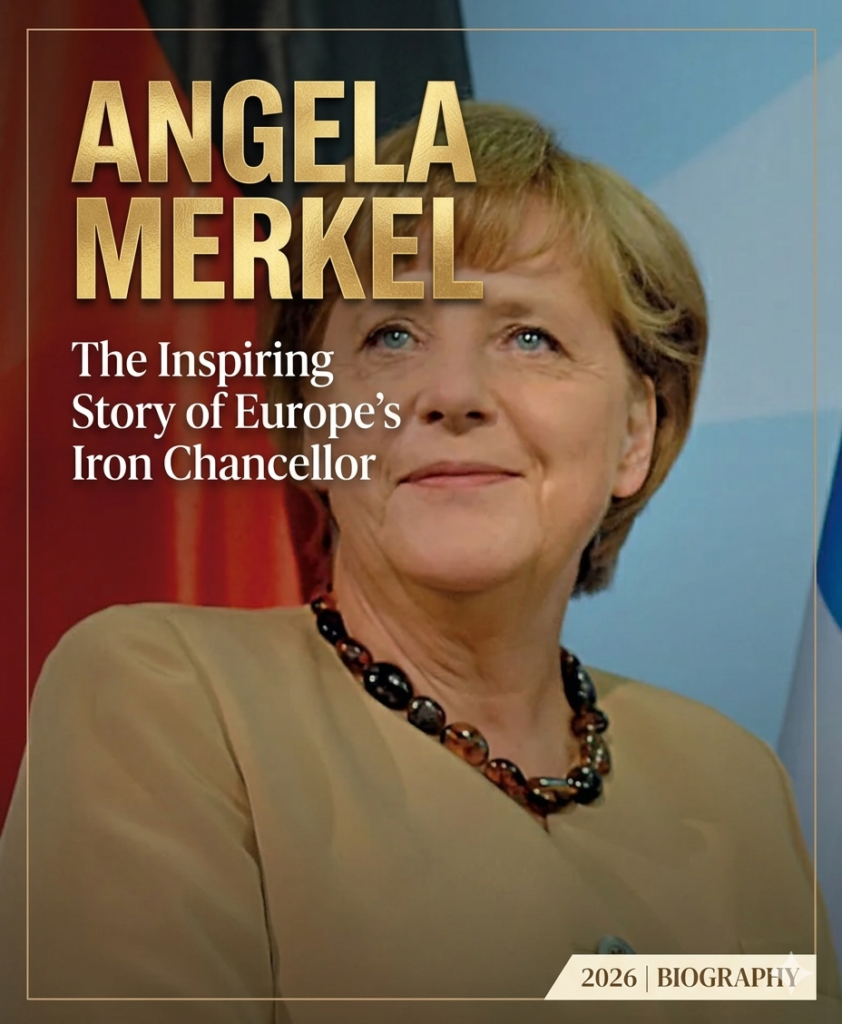

For sixteen years, the political center of Europe sounded less like thunder and more like measured footsteps across a laboratory floor.
No dramatic hand gestures. No soaring populist slogans. No cult of personality orbiting around charisma. Yet somehow, through banking collapses, refugee emergencies, Brexit, trade wars, a pandemic, and the slow fracture of the post-Cold War world order, one woman remained the gravitational constant holding Europe together.
That woman was Angela Merkel.
Born behind the shadows of postwar division and trained as a quantum chemist in East Germany, Merkel became one of the most consequential political leaders of the 21st century. She was never supposed to dominate global politics. She didn’t come from aristocracy, celebrity, military power, or dynastic influence. She came from equations, research papers, and the disciplined habits of a scientist trained to distrust emotional noise.
And perhaps that is precisely why she lasted.
By 2026, Merkel has long stepped away from the Chancellery, but her influence still lingers across Europe like architectural steel hidden beneath a skyline. Modern Germany still bears her fingerprints. So does the European Union. So does the global idea that power can be exercised without spectacle.
This is the full Angela Merkel biography: her early life, rise to power, political philosophy, controversies, personal life, net worth in 2026, and the enduring legacy of the woman many once called simply Mutti.
Quick Facts Angela Merkel at a Glance
| Detail | Information |
|---|---|
| Full Name | Angela Dorothea Merkel (née Kasner) |
| Date of Birth | July 17, 1954 |
| Birthplace | Hamburg, West Germany |
| Nationality | German |
| Occupation | Former Chancellor, Scientist, Author |
| Political Party | Christian Democratic Union (CDU) |
| Chancellor of Germany | 2005 – 2021 |
| Education | PhD in Quantum Chemistry |
| Spouse | Joachim Sauer |
| Net Worth (2026) | Estimated $11–$13 million |
| Known For | Leading Germany through multiple global crises |
Early Life Growing Up Behind the Iron Curtain
Angela Dorothea Kasner was born on July 17, 1954, in Hamburg, West Germany, during a period when Europe still carried the bruises of World War II.
But almost immediately, her story took an unusual turn.
Just weeks after her birth, her father, Horst Kasner, a Lutheran pastor, moved the family from West Germany into East Germany, officially the German Democratic Republic (GDR). At a time when countless East Germans were trying desperately to escape westward, the Kasner family moved in the opposite direction.
They settled in the small town of Templin, north of Berlin.
That decision shaped Merkel permanently.
Life inside Communist East Germany rewarded caution, observation, and restraint. Public speech carried consequences. Emotion was private. Precision mattered. Those traits would later become defining elements of Merkel’s political personality.
As a child, she excelled academically, especially in mathematics, physics, and Russian. Teachers quickly recognized her analytical mind. Unlike many future politicians, Merkel was not drawn to debate clubs or student activism. She preferred logic to rhetoric and systems to spectacle.
Years later, world leaders would discover something remarkable about her: Merkel rarely forgot details. Statistics, timelines, negotiation positions, policy clauses. Her memory operated like an indexed archive.
It was less politician, more operating system.
Education The Scientist Before the Stateswoman
Merkel’s intellectual path led her to the University of Leipzig, where she studied physics from 1973 to 1978.
Physics appealed to her because, in her own words, it dealt in truths that ideology could not easily manipulate. In Communist East Germany, that mattered.
After graduating, she worked at the Central Institute for Physical Chemistry at the Academy of Sciences in East Berlin, eventually earning a doctorate in quantum chemistry in 1986.
Her dissertation focused on reaction rates in chemistry, hardly the kind of work that hints at future geopolitical dominance. Yet the habits of scientific inquiry became central to her governing style:
- Analyze before reacting
- Gather data before speaking
- Avoid unnecessary risk
- Think in systems, not headlines
- Stay emotionally disciplined under pressure
This “physics mindset” later became known informally among diplomats as the Merkel Method.
While many politicians operated like actors on a stage, Merkel approached politics like a scientist debugging unstable software.
The Fall of the Berlin Wall Changed Everything
For most of the 1980s, Angela Merkel appeared destined for a quiet scientific career.
Then history detonated.
The collapse of Communist regimes across Eastern Europe culminated in the fall of the Fall of the Berlin Wall in November 1989.
Suddenly, the world Merkel had known ceased to exist.
Unlike many revolutionaries, she was not a fiery dissident. She entered politics cautiously, joining a small democratic movement called Democratic Awakening. Her calm intelligence quickly attracted attention inside the newly transforming political landscape.
Following German reunification in 1990, she joined the Christian Democratic Union (CDU), where she caught the eye of Chancellor Helmut Kohl.
Kohl famously referred to her as mein Mädchen (“my girl”), mentoring her into cabinet positions. Critics initially underestimated her, viewing her as politically harmless.
That miscalculation became one of the great strategic errors in modern German politics.
The Rise to Power How Angela Merkel Took Control of Germany
Merkel’s defining political moment arrived in the late 1990s.
The CDU became engulfed in a party financing scandal tied to Helmut Kohl. Most party figures hesitated, fearful of challenging the man who had reunified Germany.
Merkel did not hesitate.
In a bold newspaper editorial, she publicly argued that the party needed to separate itself from Kohl and modernize. It was a ruthless act of political survival disguised as principle.
It worked.
By 2000, Merkel became leader of the CDU. Five years later, after tense coalition negotiations, she became Germany’s first female Chancellor and the first former East German to hold the office.
Many expected her government to be short-lived.
Instead, she would remain Chancellor from 2005 until 2021, longer than almost any major democratic leader of her era.
Chancellor Merkel The Woman Who Held Europe Together
Angela Merkel governed during one of the most turbulent periods in modern European history.
And turbulence became her specialty.
The Global Financial Crisis
When the 2008 financial crisis ripped through global markets, Merkel positioned Germany as the stabilizing force of Europe.
Critics sometimes called her too cautious. Supporters called her disciplined. But while governments collapsed elsewhere, Germany remained comparatively resilient.
Her fiscal conservatism helped define the European response to debt crises in Greece, Portugal, and Spain.
The Eurozone Crisis
During the sovereign debt crisis, Merkel effectively became the unofficial leader of the European Union.
At times, European markets appeared to move based on her facial expressions alone.
She pushed for austerity measures that drew heavy criticism in Southern Europe, where many viewed Germany as imposing economic pain on struggling nations. Yet supporters argued she prevented the collapse of the euro itself.
The Refugee Crisis
Perhaps no decision defined Merkel’s moral legacy more than the 2015 refugee crisis.
As war devastated Syria and instability spread across parts of the Middle East and Africa, over a million refugees entered Germany.
Merkel responded with the phrase:
“Wir schaffen das.”
“We can do this.”
To supporters, it was one of the most humane acts by a modern Western leader.
To critics, it accelerated political polarization across Europe and fueled the rise of nationalist movements.
Even in 2026, historians continue debating whether it was visionary leadership or a catastrophic political gamble.
COVID-19 Pandemic
Merkel’s scientific background became especially visible during the COVID-19 pandemic.
Unlike many world leaders, she explained infection curves, reproduction rates, and public health measures with technical clarity.
Her calm televised addresses became widely respected internationally. Germans often described her communication style during the pandemic as reassuring without being manipulative.
She spoke to citizens like adults, not audiences.
Angela Merkel Net Worth in 2026
As of 2026, Angela Merkel’s estimated net worth sits between $11 million and $13 million.
Compared to corporate billionaires or celebrity politicians, her wealth is relatively modest. That is partly because Merkel spent most of her career in public service rather than private enterprise.
Her financial profile includes:
- Chancellor salary and government pension
- Book royalties from her memoir Freedom: Memories 1954–2021
- Paid speaking engagements
- Academic appearances and advisory roles
- Investment income and personal assets
Unlike many former world leaders, Merkel has avoided aggressive monetization of her political fame. She has not launched a media empire, cryptocurrency project, or lobbying consultancy.
Her lifestyle remains famously restrained.
She still maintains a modest Berlin apartment and a country property in Uckermark rather than multiple luxury estates scattered across continents.
In an age where political power often mutates into commercial spectacle, Merkel’s financial footprint feels almost startlingly old-fashioned.
Personal Life The Private World of Angela Merkel
Angela Merkel married quantum chemist Joachim Sauer in 1998.
Sauer is intensely private and became known in German media as “the Phantom of the Opera” because he rarely appeared publicly except at major cultural events like the Bayreuth Wagner Festival.
Their marriage operates with unusual distance from celebrity culture. No political branding. No curated intimacy for public consumption.
Merkel has no biological children, though she is close to Sauer’s sons from a previous marriage.
One reason Germans often trusted her was because her personal life appeared remarkably ordinary:
- Grocery shopping without spectacle
- Cooking at home
- Minimal luxury displays
- No obsession with fashion or image-making
- Rarely emotional in public
Her trademark blazer jackets became almost symbolic of her political style: functional, repetitive, quietly efficient.
Controversies and Criticism
No sixteen-year leadership era escapes criticism.
Russia and Energy Dependence
One of the largest criticisms of Merkel’s legacy involves Germany’s energy relationship with Russia.
Her support for the Nord Stream 2 controversy pipeline is now viewed by many critics as strategically dangerous, particularly after Russia’s invasion of Ukraine.
Opponents argue Germany became too dependent on Russian gas under her leadership.
Supporters counter that much of Europe shared similar assumptions at the time and that Merkel believed economic interdependence would reduce geopolitical conflict.
Refugee Policy Backlash
Her refugee policy also permanently reshaped German politics.
While internationally praised by many humanitarian groups, it energized far-right political movements domestically, particularly the Alternative for Germany (AfD).
The debate remains emotionally charged across Europe.
Leadership Style Criticism
Some critics argued Merkel governed reactively rather than proactively, often waiting until crises forced action.
Others saw that patience as her greatest strength.
Merkel rarely rushed. She absorbed pressure until opponents exhausted themselves.
Then she moved.
Legacy Why Angela Merkel Still Matters in 2026
Angela Merkel transformed global expectations of leadership.
She demonstrated that political strength does not always require theatrical aggression. She proved restraint could be strategic. She showed that intelligence, patience, and technical competence could still command democratic trust in an age addicted to outrage.
Her leadership style now feels almost historically unusual.
No cult.
No spectacle.
No personal mythology machine.
Just endurance.
In many ways, Merkel governed like a bridge between two political eras: the slower, institutional postwar world and the hyper-chaotic digital age that followed.
Even after retirement, she remains one of the most respected political figures of the modern era.
For younger generations, especially women entering politics, science, diplomacy, and public service, Merkel became evidence that authority does not need to imitate masculinity to become powerful.
The laboratory-trained girl from East Germany ended up steering Europe through some of its most dangerous storms.
History rarely predicts its protagonists correctly.
Frequently Asked Questions (FAQ)
What is Angela Merkel’s net worth in 2026?
Angela Merkel’s estimated net worth in 2026 is between $11 million and $13 million, primarily derived from government pensions, memoir royalties, speaking engagements, and investments.
How did Angela Merkel become famous?
She became internationally famous after becoming Germany’s first female Chancellor in 2005. Her leadership during the financial crisis, refugee crisis, Brexit era, and COVID-19 pandemic elevated her into one of the world’s most influential political figures.
Where is Angela Merkel from?
Angela Merkel was born in Hamburg, West Germany, but grew up in East Germany after her family relocated there shortly after her birth.
What did Angela Merkel study?
She studied physics at the University of Leipzig and later earned a doctorate in quantum chemistry in East Berlin.
Is Angela Merkel married?
Yes. Angela Merkel has been married to quantum chemist Joachim Sauer since 1998.
Why was Angela Merkel called “Mutti”?
Many Germans nicknamed her Mutti (“Mother”) because of her calm, protective, and stabilizing leadership style during periods of national and international crisis.
What is Angela Merkel’s biggest legacy?
Her greatest legacy is widely considered her role in stabilizing Europe during multiple global crises while redefining modern leadership through pragmatism, discipline, and quiet authority.
Last updated:
May 2026. Financial estimates and biographical details are based on publicly available records, verified interviews, memoirs, and institutional reporting available at the time of publication.