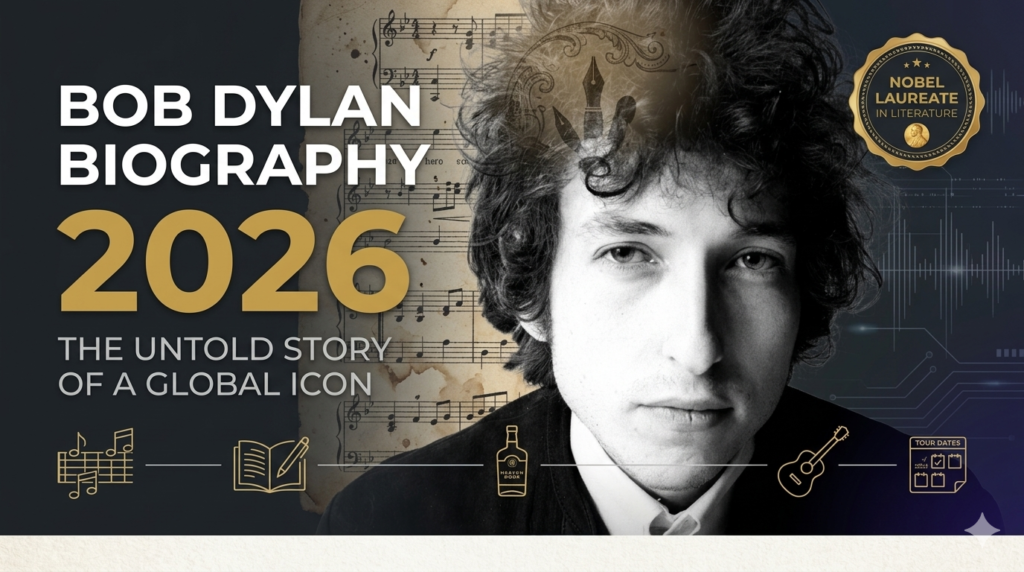

Bob Dylan Biography 2026 The Restless Poet Who Rewired American Music
There are artists who become famous.
Then there are artists who alter the vocabulary of culture itself.
Bob Dylan belongs firmly in the second category.
Born Robert Allen Zimmerman in a mining town in Minnesota, Dylan transformed himself from a restless teenager obsessed with blues records into one of the most influential writers of the modern age. Over six decades, he has been a folk singer, protest poet, rock revolutionary, country crooner, gospel preacher, radio host, novelist, painter, whiskey entrepreneur, and Nobel Prize laureate. Somehow, he has managed to be all of those things while remaining fundamentally unknowable.
That mystery is part of the power.
Even in 2026, now deep into his eighties, Dylan continues touring the world with the same stubborn intensity that defined him in the 1960s. The so-called Never Ending Tour still rolls across continents like a wandering American railroad ghost, gathering generations of listeners in theaters, arenas, and old concert halls where audiences come not just to hear songs, but to witness an artist who never stopped evolving.
This is the full Bob Dylan biography: his early life, career journey, net worth in 2026, personal life, controversies, and the extraordinary legacy of the man who turned songwriting into literature.
Quick Facts Bob Dylan at a Glance
| Detail | Information |
|---|---|
| Full Name | Robert Allen Zimmerman |
| Stage Name | Bob Dylan |
| Date of Birth | May 24, 1941 |
| Birthplace | Duluth, Minnesota, USA |
| Nationality | American |
| Occupation | Singer-songwriter, Author, Visual Artist |
| Genres | Folk, Rock, Blues, Country, Gospel |
| Net Worth (2026) | Estimated $500 million |
| Known For | “Blowin’ in the Wind,” “Like a Rolling Stone,” Nobel Prize in Literature |
| Children | 6 |
| Active Years | 1961 – present |
Early Life Robert Zimmerman Before He Became Bob Dylan
Bob Dylan was born Robert Allen Zimmerman on May 24, 1941, in Duluth and raised primarily in the mining town of Hibbing, Minnesota.
His parents, Abram Zimmerman and Beatrice “Beatty” Stone, were part of a close-knit Jewish community built around the rugged economy of Minnesota’s Iron Range. His upbringing was stable, middle class, and far removed from the mythic drifter image Dylan would later cultivate.
But internally, something restless was already humming.
As a teenager, he became obsessed with the radio. At night, distant blues and country stations drifted into Minnesota from the American South like contraband signals from another universe. Those broadcasts introduced him to artists like Muddy Waters, Hank Williams, and Little Richard.
The effect was volcanic.
He formed garage bands, performed rock-and-roll covers, and reportedly played so loudly during a school talent show that administrators cut off the sound system mid-performance.
That instinct never really left him.
Throughout his life, Dylan has treated rules the way stray cats treat closed doors: temporary obstacles.
College, Folk Music, and Reinvention
In 1959, Zimmerman enrolled at the University of Minnesota.
Academics quickly became secondary.
What truly changed his life was Minneapolis’ Dinkytown folk scene, where coffeehouses echoed with acoustic guitars, political songs, and old American ballads. There, he discovered the music of Woody Guthrie, whose raw storytelling permanently reshaped Dylan’s artistic direction.
Around this period, Robert Zimmerman reinvented himself as “Bob Dylan,” likely inspired in part by Welsh poet Dylan Thomas, though Dylan later gave contradictory explanations because consistency has never interested him much.
By 1961, he dropped out of college and hitchhiked to New York City.
He arrived nearly broke, carrying ambition large enough to bend American music around it.
Greenwich Village and the Rise of a Folk Prophet
Early 1960s Greenwich Village was a furnace of creativity.
Folk music revivalists, beat poets, civil rights activists, and antiwar thinkers crowded tiny clubs thick with cigarette smoke and political urgency. Dylan fit the scene instantly, though even then he stood apart.
His voice was rough.
His harmonica sounded like rusted train brakes.
His lyrics felt ancient and futuristic at the same time.
After receiving a glowing review in The New York Times, Dylan signed with Columbia Records under producer John Hammond.
His breakthrough came with the 1963 album The Freewheelin’ Bob Dylan.
Songs like:
- Blowin’ in the Wind
- A Hard Rain’s a-Gonna Fall
- Masters of War
became anthems for the civil rights and antiwar movements.
At just 22 years old, Dylan was suddenly treated like the conscience of a generation.
He hated that role almost immediately.
Going Electric The Night Bob Dylan Changed Rock Music
In 1965, Dylan detonated one of the most controversial moments in music history.
At the Newport Folk Festival, he walked onstage carrying a Fender Stratocaster and performed with a full electric band.
Some audience members booed. Folk purists felt betrayed. Critics accused him of abandoning authenticity for commercialism.
But Dylan was already moving somewhere else creatively.
That same period produced Like a Rolling Stone, widely regarded as one of the greatest songs ever recorded. At six minutes long with surreal imagery and emotional fury, it shattered expectations for what popular music could achieve.
Before Dylan, pop lyrics often revolved around romance and dance-floor simplicity.
After Dylan, songs could contain literature, politics, philosophy, rage, symbolism, and existential dread.
He didn’t just change folk music.
He expanded the architecture of songwriting itself.
Reinvention Across the Decades
Most artists spend careers protecting a successful formula.
Dylan spent his destroying his own.
Country and Americana
Albums like Nashville Skyline revealed a softer country-inspired sound that shocked fans expecting political poetry.
Gospel Era
In the late 1970s, Dylan underwent a Christian conversion and released explicitly religious albums including Slow Train Coming.
Some fans recoiled. Others admired the creative fearlessness.
Dylan ignored both groups and kept moving.
The Never Ending Tour
Beginning in 1988, Dylan launched what became known as the Never Ending Tour, performing roughly 100 shows annually for decades.
The tour transformed him into something almost mythological: a permanent traveler wandering through theaters and arenas night after night, endlessly rearranging his own songs into new forms.
A Bob Dylan concert often feels less like nostalgia and more like encountering an old river that changes shape every time you see it.
The Late-Career Renaissance
Most artists fade into legacy status.
Dylan somehow surged again.
Albums like:
- Time Out of Mind
- Love and Theft
- Rough and Rowdy Ways
were critically acclaimed and commercially successful, proving his songwriting remained astonishingly sharp deep into old age.
Then came the ultimate institutional recognition.
In 2016, Bob Dylan received the Nobel Prize in Literature, becoming the first songwriter ever to win the award.
The decision triggered debate across literary circles.
Was songwriting literature?
Dylan’s career had already answered that question decades earlier.
Bob Dylan Net Worth in 2026
As of 2026, Bob Dylan’s estimated net worth is approximately $500 million.
Much of this fortune comes from historic catalog sales completed late in his career.
Universal Music Deal
In 2020, Dylan sold his songwriting catalog, containing roughly 600 songs, to Universal Music Publishing Group for an estimated $300–$400 million.
The catalog included classics such as:
- “Blowin’ in the Wind”
- “Tangled Up in Blue”
- “Knockin’ on Heaven’s Door”
- “Like a Rolling Stone”
It was one of the largest songwriting acquisitions in music history.
Sony Music Deal
In 2022, Dylan sold his master recordings to Sony Music Entertainment in another massive deal reportedly worth between $150 million and $200 million.
Combined, these agreements secured his financial legacy permanently.
Sources of Wealth
Bob Dylan’s wealth comes from multiple streams:
Music Royalties
More than 125 million records sold worldwide continue generating enormous revenue through streaming, licensing, and publishing.
Touring
Even in his eighties, Dylan remains a major touring artist whose performances consistently sell out globally.
Art and Literature
Beyond music, Dylan is an accomplished painter and visual artist whose works appear in galleries internationally.
Whiskey Business
In 2018, he co-founded Heaven’s Door, a premium whiskey company blending Americana branding with Dylan’s artistic identity.
Film and Licensing
His songs remain heavily licensed for films, television, and advertising, generating ongoing income decades after release.
Personal Life The Man Behind the Myth
Bob Dylan has spent most of his life protecting his privacy with near-military discipline.
He has been married twice:
- Sara Dylan (1965–1977)
- Carolyn Dennis (1986–1992)
His marriage to Carolyn Dennis remained secret for years, perfectly illustrating how carefully Dylan separated public mythology from private reality.
He has six children, including Jakob Dylan, frontman of The Wallflowers.
Despite enormous fame, Dylan has often preferred isolation over celebrity culture. He reportedly spends time between properties in California, New York, and Minnesota while continuing to travel extensively.
Those close to him often describe him as deeply intelligent, unpredictable, funny, guarded, and permanently restless.
Like one of his own songs, he never entirely resolves into a single meaning.
Controversies and Criticism
Dylan’s career has never existed free from criticism.
“Selling Out”
When he went electric in 1965, folk traditionalists accused him of betraying political authenticity for commercial success.
History eventually treated that accusation like a museum artifact.
Plagiarism Debates
Critics have periodically accused Dylan of borrowing phrases and themes from older writers, blues musicians, and folk traditions.
Dylan has largely dismissed such criticism, arguing that folk and blues music have always evolved through reinterpretation and transformation.
Legal Allegations
In 2021, Dylan faced a civil lawsuit involving allegations dating back to the 1960s. The case was later dismissed, and no criminal findings were made against him.
As always, Dylan remained publicly silent.
Legacy Why Bob Dylan Still Matters in 2026
Bob Dylan did something extraordinarily rare:
He permanently changed how people think.
Not just about music. About language itself.
Before Dylan, popular songs were often treated as disposable entertainment. After Dylan, songwriting became capable of carrying philosophical depth, literary symbolism, political critique, and emotional ambiguity on the same level as poetry or novels.
His influence stretches across generations and genres:
- The Beatles
- Bruce Springsteen
- Patti Smith
- Kendrick Lamar
- Joni Mitchell
all carry traces of Dylan’s influence.
His lyrics are studied in universities. His songs remain protest tools, spiritual meditations, and emotional companions for millions.
And perhaps most remarkably, he never froze himself in nostalgia.
Even in old age, Dylan continues forward like a traveler refusing to unpack his suitcase.
That refusal to become predictable may be the truest thing about him.
Frequently Asked Questions (FAQ)
What is Bob Dylan’s net worth in 2026?
Bob Dylan’s estimated net worth in 2026 is approximately $500 million, driven largely by historic catalog sales, touring revenue, publishing rights, and business ventures like Heaven’s Door whiskey.
How did Bob Dylan become famous?
He became famous during the early 1960s folk revival in New York City through politically charged songs like “Blowin’ in the Wind” and “The Times They Are a-Changin’.”
Where is Bob Dylan from?
Bob Dylan was born in Duluth, Minnesota, and raised primarily in Hibbing, Minnesota.
Why did Bob Dylan win the Nobel Prize?
He received the Nobel Prize in Literature in 2016 for creating “new poetic expressions within the great American song tradition.”
Is Bob Dylan still touring in 2026?
Yes. Bob Dylan continues performing live as part of his long-running global touring schedule associated with the Rough and Rowdy Ways era.
Was Bob Dylan married?
Yes. He has been married twice, first to Sara Dylan and later to Carolyn Dennis.
What is Bob Dylan’s most famous song?
While opinions vary, “Like a Rolling Stone” is widely considered his signature masterpiece and one of the greatest songs in modern music history.
Last updated:
May 2026. Financial figures are based on publicly available reporting, music industry estimates, and catalog valuation disclosures available at the time of publication.