
Last Updated: May 2026
Written by Adrian Cole
Science and Technology Journalist
Adrian Cole covers cosmology, physics, artificial intelligence, and the lives of scientists whose work reshaped modern thought. His reporting focuses on making complex ideas accessible without losing scientific depth.
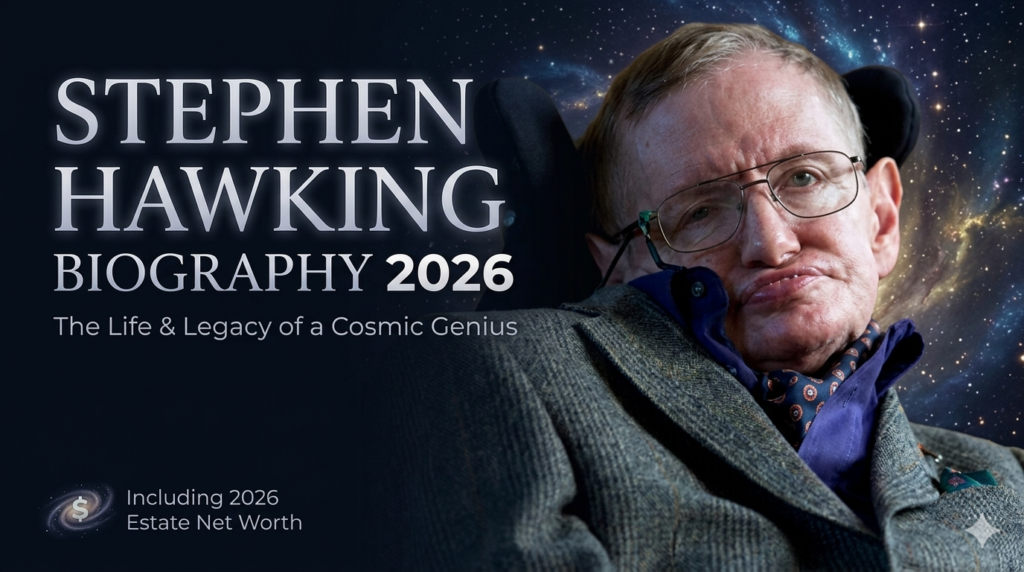
Stephen Hawking Wasn’t Just a Scientist. He Became a Symbol of Human Possibility.
Few scientists in modern history achieved the level of cultural impact that Stephen Hawking did.
He wasn’t simply a brilliant physicist buried in equations and academic journals. He became something much larger: a global symbol of intellectual endurance, scientific curiosity, and the refusal to surrender to impossible odds.
Confined to a wheelchair for most of his adult life and speaking through a computerized voice synthesizer, Hawking spent decades exploring questions that many people consider almost unanswerable:
How did the universe begin?
What happens inside a black hole?
Can time itself have a starting point?
And somehow, he translated those questions into language millions of ordinary readers could understand.
By the time of his death in 2018, Stephen Hawking had become one of the most recognizable scientists on Earth. His books sold tens of millions of copies. His theories reshaped modern cosmology. His life story inspired people far beyond the scientific community.
Even in 2026, his work continues to influence:
- black hole research
- quantum physics
- cosmology
- artificial intelligence debates
- disability advocacy
- science education worldwide
This Stephen Hawking biography explores his early life, education, ALS diagnosis, scientific breakthroughs, books, net worth in 2026, personal struggles, controversies, and enduring legacy.
Quick Facts About Stephen Hawking
| Detail | Information |
|---|---|
| Full Name | Stephen William Hawking |
| Date of Birth | January 8, 1942 |
| Date of Death | March 14, 2018 |
| Age at Death | 76 years old |
| Birthplace | Oxford, England |
| Nationality | British |
| Occupation | Theoretical Physicist, Cosmologist, Author |
| Education | Oxford University, University of Cambridge |
| Famous For | Hawking Radiation, Black Hole Theory |
| Books | A Brief History of Time, The Universe in a Nutshell |
| Marriages | Jane Wilde (1965–1995), Elaine Mason (1995–2006) |
| Children | Robert, Lucy, Timothy |
| Estate Net Worth (2026) | Estimated $20 million |
Early Life: A Child Fascinated by How Things Worked
Stephen William Hawking was born on January 8, 1942, in Oxford, England, during the height of World War II.
His parents, Frank and Isobel Hawking, were both highly educated intellectuals who valued learning deeply. His father was a medical researcher specializing in tropical diseases, while his mother studied philosophy, politics, and economics at Oxford University at a time when few women attended university.
Interestingly, Hawking was born exactly 300 years after the death of Galileo Galilei, a coincidence he later found amusing.
The Hawking household was unconventional but intensely academic.
Books filled the home.
Dinner conversations revolved around science and politics.
Curiosity was encouraged constantly.
As a child, Hawking developed an obsession with understanding how things worked.
He dismantled clocks, radios, and household objects, often struggling to reassemble them afterward. While he was not initially viewed as an exceptional student academically, classmates quickly noticed his unusual intelligence.
Friends nicknamed him “Einstein,” partly as a joke, partly because they sensed his mind worked differently.
Oxford and Cambridge: The Formation of a Scientific Mind
At just 17 years old, Hawking entered University College, Oxford.
He originally hoped to study mathematics, but Oxford did not offer a dedicated mathematics degree at the time. Instead, he pursued physics, focusing particularly on cosmology and thermodynamics.
Despite appearing relaxed and sometimes academically lazy on the surface, Hawking possessed extraordinary analytical ability.
He completed relatively little formal studying compared to his peers yet still graduated with first-class honors.
After Oxford, Hawking moved to the University of Cambridge to pursue a PhD in cosmology.
That decision changed the course of his life.
Not only scientifically.
Personally.
Because shortly after arriving at Cambridge, something frightening began happening to his body.
The ALS Diagnosis That Changed Everything
At age 21, Hawking began experiencing:
- muscle weakness
- clumsiness
- slurred speech
- unexplained falls
Doctors eventually diagnosed him with amyotrophic lateral sclerosis (ALS), also known as motor neurone disease.
The prognosis was devastating.
He was told he likely had only two years to live.
For a young graduate student with enormous intellectual ambition, the diagnosis initially shattered him emotionally.
He later admitted he fell into a deep depression during this period.
But two things changed his outlook:
- his growing fascination with cosmology
- his relationship with Jane Wilde
Jane gave him emotional stability and a reason to continue planning for the future.
And Hawking gradually developed a new mindset:
If his time was limited, he wanted it to matter.
That urgency transformed his scientific focus and productivity.
Remarkably, he would go on to live with ALS for more than 55 years, becoming one of the longest-known survivors of the disease in history.
Scientific Breakthroughs: Black Holes and the Nature of the Universe
Stephen Hawking’s greatest contributions fundamentally changed modern cosmology.
Hawking and Roger Penrose: Singularity Theory
In the late 1960s and early 1970s, Hawking collaborated with mathematician Roger Penrose.
Together, they applied Einstein’s theory of general relativity to the origins of the universe.
Their work demonstrated that:
- if general relativity is correct
- and the universe is expanding
then the universe must have originated from a singularity: a point of infinite density and curvature.
In simpler terms:
The Big Bang was not merely an explosion inside space.
It was the beginning of space and time themselves.
This was one of the most important scientific conclusions of the 20th century.
Hawking Radiation: The Discovery That Made Him Famous
Hawking’s most revolutionary idea emerged in 1974.
At the time, scientists believed black holes absorbed everything permanently, including light.
Hawking challenged that assumption using quantum mechanics.
He discovered that black holes should actually emit tiny amounts of thermal radiation.
This process became known as Hawking Radiation.
The theory suggested:
- black holes are not entirely black
- they slowly lose energy
- they can eventually evaporate over immense timescales
This insight bridged:
- quantum physics
- thermodynamics
- Einstein’s relativity
three areas of science that had long resisted unification.
Today, Hawking Radiation remains one of the foundational concepts in theoretical physics.
A Brief History of Time: Making Science Global
In 1988, Hawking published A Brief History of Time.
The book attempted something extraordinarily ambitious:
Explaining cosmology, black holes, time, and the universe to ordinary readers without advanced scientific training.
Publishers were skeptical.
Some scientists doubted the public would care.
They were wrong.
The book became a worldwide phenomenon.
It sold more than 25 million copies and remained on bestseller lists for years.
Suddenly, Stephen Hawking became more than a physicist.
He became an international intellectual celebrity.
For millions of readers, he transformed cosmology from an intimidating academic subject into something emotionally and philosophically captivating.
Stephen Hawking’s Source of Wealth
Unlike many scientists who rely primarily on academic salaries, Hawking built substantial wealth through multiple income streams.
1. Book Royalties
His books became his largest financial success.
Major titles included:
- A Brief History of Time
- The Universe in a Nutshell
- The Grand Design
- Brief Answers to the Big Questions
These books sold globally across dozens of languages.
2. Media and Television Appearances
Hawking became a pop culture figure through appearances on:
- The Simpsons
- The Big Bang Theory
- Star Trek: The Next Generation
- documentaries and television specials
These appearances expanded both his public profile and licensing income.
3. Public Speaking and Academic Engagements
Despite severe physical limitations, Hawking remained a highly sought-after speaker and lecturer worldwide.
4. Awards and Scientific Prizes
Hawking received numerous honors and monetary awards throughout his life, including the Fundamental Physics Prize.
Stephen Hawking Net Worth in 2026
At the time of his death in 2018, Stephen Hawking’s net worth was estimated at approximately $20 million.
As of 2026, the Hawking estate remains valued at roughly the same level, sustained by:
- ongoing book royalties
- documentary licensing
- publishing rights
- educational partnerships
- media use of his image and voice
The estate also supports educational and charitable initiatives connected to:
- ALS research
- disability advocacy
- science education
Because Hawking’s work remains widely taught and commercially relevant, his intellectual legacy continues generating income years after his passing.
Personal Life: Marriage, Family, and Emotional Complexity
Stephen Hawking married Jane Wilde in 1965.
Together, they had three children:
- Robert
- Lucy
- Timothy
Jane played an essential role in supporting Hawking during the most physically difficult periods of his illness.
As his fame grew and his condition worsened, however, the pressures on the marriage intensified.
The relationship eventually ended in divorce in 1995.
That same year, Hawking married Elaine Mason, one of his nurses.
The second marriage attracted heavy media scrutiny and controversy, though both Hawking and Elaine consistently denied allegations of mistreatment that surfaced publicly.
They divorced in 2006.
Despite the emotional complexities of his personal life, Hawking maintained close relationships with his children and often spoke warmly about family.
He also retained a sharp sense of humor throughout his life.
Friends and colleagues frequently described him as:
- witty
- playful
- sarcastic
- stubborn
- intensely determined
Living With ALS: The Voice That Became Iconic
As ALS progressively paralyzed his body, Hawking gradually lost the ability to speak naturally.
He eventually communicated using a speech-generating device controlled by a single cheek muscle.
The robotic synthesized voice became globally recognizable.
Interestingly, although more advanced voice systems later became available, Hawking refused to replace it.
He said the computerized voice had become part of his identity.
The image of Hawking:
- speaking through a machine
- discussing black holes and time
- confined physically but intellectually limitless
became one of the defining scientific symbols of the modern era.
Controversies and Public Debates
Stephen Hawking was widely admired, but not universally uncontroversial.
Religion and Atheism
In later years, Hawking became increasingly outspoken about atheism.
He argued that:
- the universe could explain itself through physical laws
- a creator was not scientifically necessary
- cosmology did not require divine intervention
These comments generated intense debate among religious scholars and theologians worldwide.
Artificial Intelligence Warnings
Hawking repeatedly warned about the dangers of advanced artificial intelligence.
He argued that:
- AI could eventually surpass human intelligence
- unchecked AI development might threaten humanity
- global cooperation and regulation were necessary
Ironically, many of those warnings appear increasingly relevant in 2026.
Warnings About Human Survival
Hawking also warned repeatedly about:
- climate change
- nuclear war
- overpopulation
- pandemics
He believed humanity’s long-term survival depended partly on becoming a multi-planetary species.
Some critics viewed these warnings as excessively pessimistic.
Others viewed them as realistic scientific caution.
Legacy: Why Stephen Hawking Still Matters in 2026
Stephen Hawking’s legacy exists on multiple levels simultaneously.
Scientifically, he reshaped modern understanding of:
- black holes
- cosmology
- quantum gravity
- the origins of the universe
Culturally, he transformed public engagement with science.
Before Hawking, theoretical physics rarely occupied mainstream global conversation.
After Hawking, millions of ordinary people became fascinated by:
- time
- space
- singularities
- black holes
- the structure of reality itself
Personally, his life became a profound symbol of resilience.
He demonstrated that physical limitations do not define intellectual capacity or human value.
For people living with disabilities worldwide, Hawking represented possibility without self-pity.
He made science feel human.
And in doing so, he became immortal in a way few scientists ever do.
Stephen Hawking Career Timeline
| Year | Milestone |
|---|---|
| 1942 | Born in Oxford, England |
| 1959 | Enters Oxford University |
| 1963 | Begins PhD at Cambridge |
| 1963 | Diagnosed with ALS |
| 1974 | Develops Hawking Radiation theory |
| 1979 | Becomes Lucasian Professor at Cambridge |
| 1988 | Publishes A Brief History of Time |
| 2014 | The Theory of Everything film released |
| 2018 | Passes away at age 76 |
| 2026 | Legacy continues shaping cosmology and science education |
Frequently Asked Questions About Stephen Hawking
What was Stephen Hawking famous for?
He was famous for his groundbreaking work on black holes, cosmology, and Hawking Radiation, as well as his bestselling science books.
What was Stephen Hawking’s net worth in 2026?
His estate is estimated at approximately $20 million, supported largely by book royalties and licensing.
How long did Stephen Hawking live with ALS?
He lived with ALS for more than 55 years, far beyond the original medical expectations.
What was Hawking Radiation?
It is the theory that black holes emit thermal radiation and can eventually evaporate over time.
Was Stephen Hawking married?
Yes. He was married twice: first to Jane Wilde and later to Elaine Mason.
Editorial Note
BiographyHub independently researches biographies using verified academic archives, university records, scientific publications, interviews, documentaries, and reputable journalism. Net worth figures for estates are estimates based on publicly available information and licensing data.
Sources and References
This article references publicly available information from:
- University of Cambridge
- Oxford University
- NASA
- The Royal Society
- BBC
- Scientific American
- The New York Times
- Stephen Hawking Estate
- Published interviews and scientific papers